
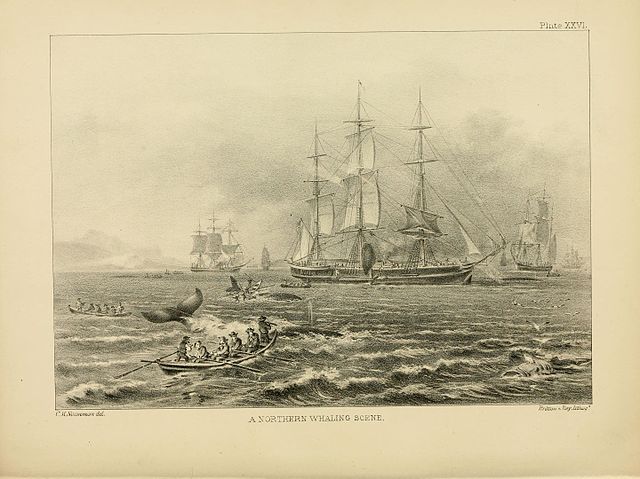
There is evidence that humans hunted whales as early as the Neolithic period. The meat from a single whale could feed a small village for months, but it was the demand for whale oil that led to the explosion of the whaling industry in the eighteenth and nineteenth centuries.
Before kerosene, lamps inside the home and out burned whale oil. It was used as a mechanical lubricant, greasing the machines of the Industrial Revolution. Corsets held their shape thanks to flexible but strong whalebone, while intricately carved scrimshaw busks made from whale’s teeth[1] held up the center and flattened the belly. Whalebone provided structure to umbrellas, and the brightest candles were made from clean-burning whale oil.
American colonists around Nantucket started hunting whales at the beginning of the 18th century. Hunting whales is not easy, but they were driven to it because the soil in that area wasn’t great for farming. They killed their first sperm whale in 1712, and they must have thought they struck gold.
The most prized whale products came from the sperm whale: ambergris and spermaceti.
Ambergris had been used in some of the world’s most luxurious perfumes for centuries, mentioned as early as the eleventh century in Nicholas of Alexandria’s Antidotarium Magnum. It was brought to the West by Arab traders, its rarity, binding properties, and earthy scent—not dissimilar to other animal-derived scents like civet and musk—driving up the price. More valuable than saffron, at one point, ambergris was worth twice its weight in gold.[2]
In 1791, England’s House of Commons summoned a master whaler to explain what, exactly, ambergris was,[3] then presumably wished they’d never asked; ambergris is half-digested fecal matter that forms in the digestive tract of sperm whales.[4]
Gross.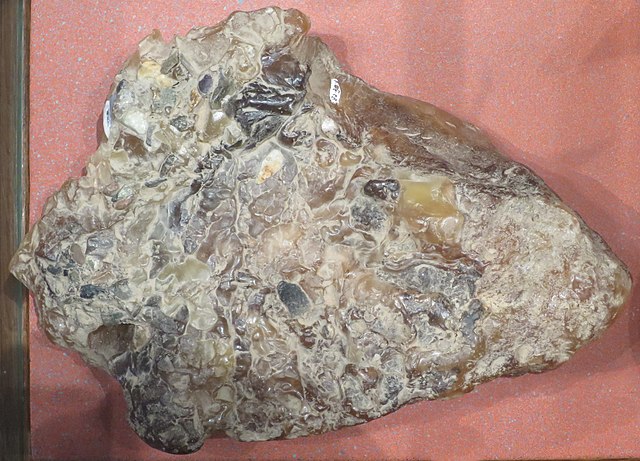
It was obtained one of two ways: by hunting, which yielded a foul-smelling product; or by chance. Ambergris naturally vomited by a sperm whale would sometimes be found floating in the sea or washed up on beaches. Pieces could be huge; the Dutch East India Company once had a piece of ambergris weighing 975lbs. The best ambergris was found; the sea water weathered the ambergris for long periods of time, transforming the smell into something altogether more pleasant over time.[5]
It didn’t stop them from harvesting it from whale carcasses, however. In nineteenth-century New Bedford, a 100lb piece of ambergris could sell for $10,000 – $20,000,[6] or $385,000 – $775,000 today.
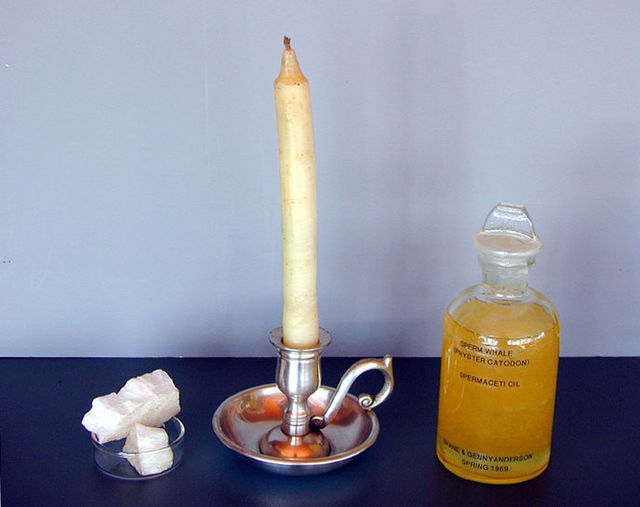
Ambergris wasn’t the only reason whalers hunted sperm whales. Nearly as valuable and far more plentiful was spermaceti, a waxy substance produced by the spermaceti organ inside the whale’s head. It was named spermaceti (in Latin, sperma ceti means “whale sperm”) due to its appearance; milky white and liquid when fresh, it resembles male ejaculate. There are credible theories that spermaceti assists whales with buoyancy and echolocation, with up to 500 gallons in the head cavity of each sperm whale.
Regular whale oil was still used for lamps, but the best oil and candles were made from spermaceti. Smokeless and scentless, it burned cleaner and brighter than other whale oil, and it cost eight times as much. In 1850, Hadwen & Barney Oil and Candle Factory’s annual output of 4,000 boxes of spermaceti candles and 450,000 gallons of sperm oil were valued at $300,000[7], or more than $11 million today.
 New Bedford, Massachusetts became known as “the city that lit the world.” It was home to 640 whaling ships, more than the rest of the world combined and tripled.[8] Whale products were shipped around the world, with New Bedford products reaching Europe, South America, and the West Indies. At the height of its success, New Bedford stocked more than 5,000 streetlamps in London.[9] At this time, New Bedford was the richest city per capita in the world.
Whaling was so profitable and so necessary to American industry that despite its dangers, thousands of men took jobs aboard whaling ships, setting out on voyages that could take years at a time. Can you imagine that? You’re not going away for a week or a month, but sailing for years to remote parts of the sea to hunt the largest mammals on earth, knowing that if anything goes wrong, you could become stranded or drown.
Still, lots of people did it. It was an adventure, but there were also few jobs that paid as well. Whaling was incredibly lucrative, and it was typical for the crew to split the proceeds from the sale of the whale products. If you had a few good trips or were lucky enough to find some ambergris, the money could set you up for life—or, oddly enough, it could save your life.
Most people don’t realize that there was a maritime dimension to the Underground Railroad. Enslaved people in the deep south did not only work on plantations. Many worked on ships in various capacities, and over the years, several used their sailing knowledge and seized opportunities to make their escape, sailing to the north in a more direct and less dangerous trip than travelling on foot. When they made it to the north, whaling was an opportunity to make sure they weren’t re-captured. They could set out on a whaling voyage and be gone for years, only to return free and with a decent amount of money in their pockets. Whaling was open to men of all races. Many whalers were Black, and there was even a Black whaling captain, Absalom Boston of Nantucket. [10]
Whaling was big business, but it was also one of the most dangerous things you could do. In the second of half of this episode, we’re going to talk about how dangerous it could get. It’s going to get pretty dark, so before we get there, we’re going to have a little interlude talking about something quite a bit lighter—this next segment is about how whale products were used in 19th century makeup.
Making Spermaceti Cosmetics at Home
Before the twentieth century, a lot of cosmetics were made in the home, with recipes for common products like soap, salve, face cream, and pomade appearing in popular recipe books and ladies’ magazines like Godey’s Lady’s Book, which was published in Philadelphia between 1830 and 1878. These recipes share a number of common ingredients, and among the ones we might recognize, such as coconut oil and rose water—there are a few that are no longer sold at the market.
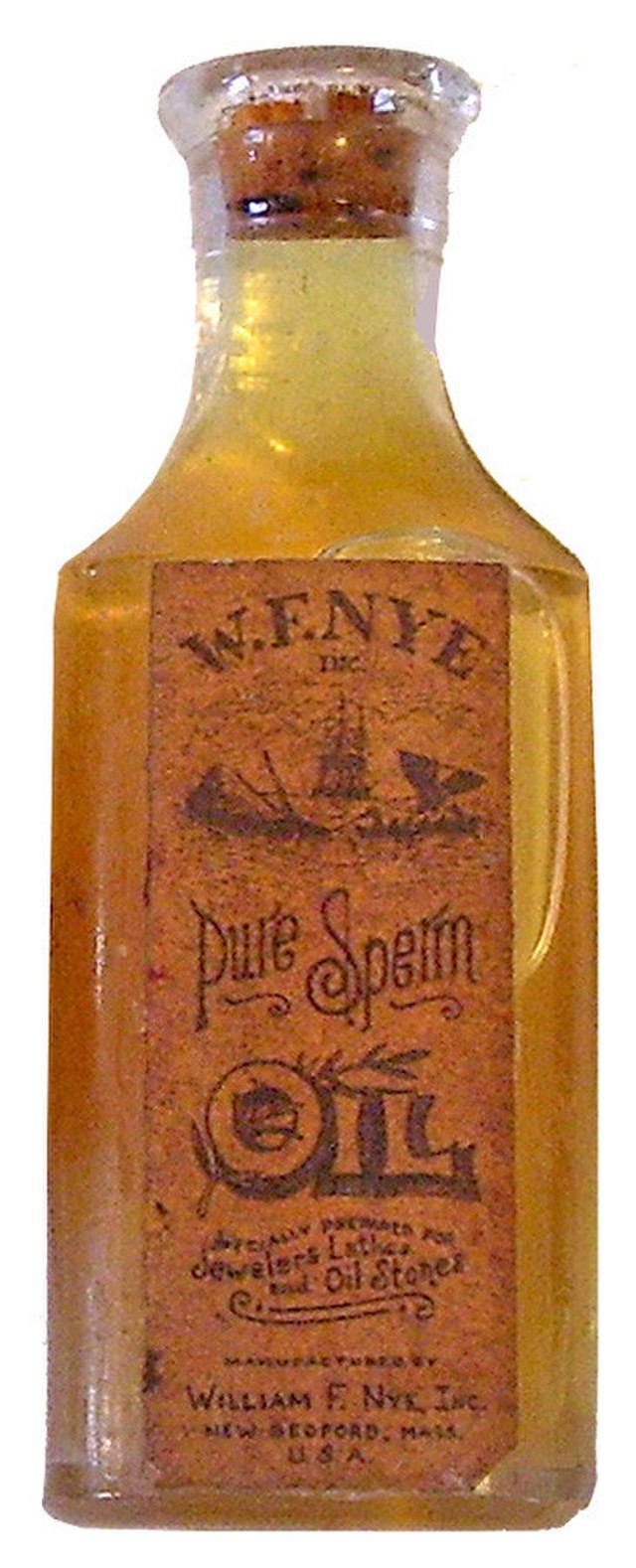 One of the most popular ingredients for nineteenth century cosmetics was spermaceti.[11] That almost no one has heard of it now would seem unimaginable to a woman in nineteenth-century America. Their homes were lit with it, you could buy it at the market, and it was a great moisturizer.
Spermaceti could be bought at the market for a number of household uses, and it comes up a lot in the recipe section of Godey’s Ladies’ Book. Like, a lot, a lot. Because I’m a nerd, I’ve spent a lot of this year up to the eyeballs in old copies of Godey’s Ladies’ Book, and I was surprised by just how often spermaceti comes up. I knew it was a whale product, but it was hard to imagine what you’d have to do to it to get it to a point where you’d want to rub it all over your face. To help us understand this part of women’s daily lives, I thought it would be fun to share a couple of these recipes with you today.
These recipes come from different issues of Godey’s Ladies’ Book from 1863. Right in the middle of the American Civil War, women made their own face cream with whale products. First up, we have a hand lotion:
“FOR CHAPPED HANDS.—Two ounces of white wax, two ounces of hog’s lard rendered, half an ounce of spermaceti, one ounce of oil of sweet almonds. Simmer all these ingredients together for a few minutes, then strain the liquid through muslin, and put into pots. To be rubbed well over the hands when going to bed, and sleep with gloves on.”
A cold cream for the face was made using a similar method. Next up, we have a recipe for lipstick:
“RED LIP SALVE.—Take of white wax, four ounces ; olive oil, four ounces ; spermaceti, half an ounce ; oil of lavender twenty drops ; alkanet root, two ounces. Macerate the alkanet for three or four days in the olive oil ; then strain and melt in it the wax and spermaceti ; when nearly cold, add the oil of lavender, and stir it till quite firmly set.”
The color of this was probably more vivid than you’d expect. When you see this time period represented in TV and movies, a lot of the women look like they’ve never seen makeup, let alone considered wearing it. But alkanet root powder, the dye used here, creates a lovely deep rose color that wouldn’t look out of place today.
And finally, we have
HAIR POMATUM (pomade). — To a flask of the finest Lucca oil add an ounce and a half of spermaceti, half an ounce of white wax, and scent of any kind. Cut up the wax and spermaceti, and put it in the oven to melt with a little of the oil. When well mixed, pour in the remainder of the oil, and stir until cold : add the scent when the mixture is cool. If the hair is inclining to gray, add, by drops, a teaspoonful of balsam of Peru, taking care to stir it well in.
Lucca oil is a type of olive oil, so any Lucas out don’t have to worry about women hunting them with spears.
Needless to say, these recipes were not cruelty free or vegan. But they were popular, and they seem to have worked. We’ll never get to try them ourselves, which is honestly a good thing—seriously, save the whales—but if you want to get very close, you can, and you probably already are. Since the end of whaling, jojoba oil has been found to be virtually identical to spermaceti, and now it replaces it in common cosmetics. So every time you use jojoba oil, think about those ladies rubbing spermaceti into their skin back in 1863 and know that your experience isn’t a million miles off.
Jessica Cale
This story was featured in Season 3, Episode 4 of the Dirty Sexy History podcast, which you can listen to here.
Sources
[1] Nancy Shoemaker. Oil, Spermaceti, Ambergris, and Teeth: Products of the Nineteenth-Century Pacific Sperm-Whaling Industry. p. 17-22
[2] Sally Pointer, The Artifice of Beauty, p. 174
[3] Ibid, p. 174
[4] Shoemaker, p. 17-22
[5] Pointer, p. 174.
[6] Shoemaker, p. 19.
[7] Mike MacEacheran. The City that Lit the World. BBC Travel, 20th July 2018.
[8] Derek Thompson, The Spectacular Rise and Fall of U.S. Whaling: An Innovation Story. The Atlantic. February 22, 2012.
[9] Ibid.
[10] Timothy D. Walker. Sailing to Freedom: Maritime Dimensions of the Underground Railroad. University of Massachusetts Press, 2021.
[11] Evidenced by numerous recipes appearing Godey’s Lady’s Book (1830 – 1878) and The Ugly-Girl Papers by S.D. Powers (1874). The Ugly-Girl Papers was a beauty advice column published in Harper’s Bazar during the 1870s.
Pictures:
- Charles Melville Scammon. A Northern Whaling Scene, 1874.
- A piece of ambergris. Skagway Museum. Public domain.
- Genevieve Anderson. A sample of spermaceti wax, a spermaceti candle, and a jar of sperm oil. CC BY-SA 3.0.
- A bottle of sperm oil. Public domain.

