
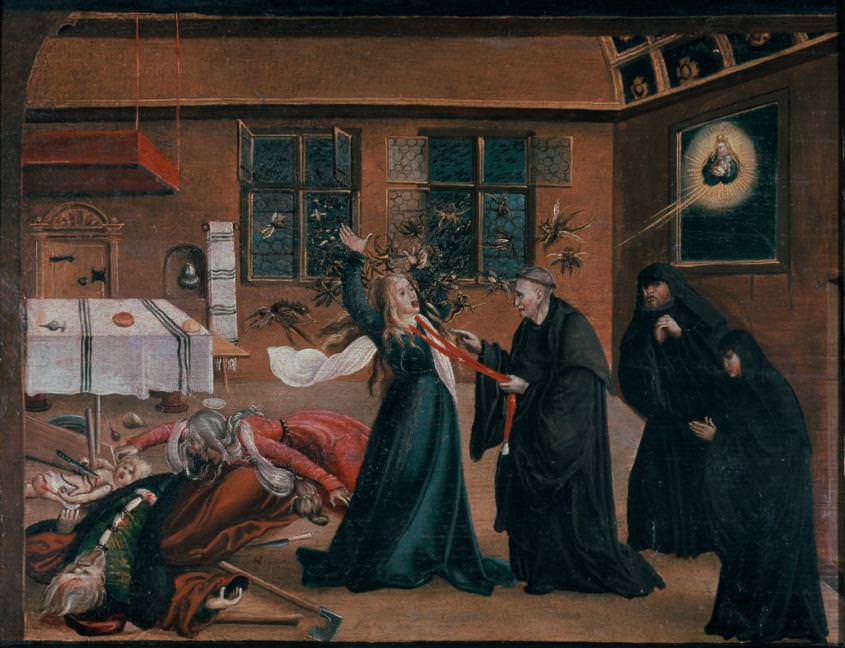
You’re probably familiar with the historical concept of “hysteria”—that is, the idea that most women’s real health problems and perceived madness could be blamed on their uterus. For centuries, the uterine function was poorly understood and menstruation often taken as evidence of women’s fundamentally flawed and inherently evil nature.
As far back as Hippocrates, it was commonly believed that regular menstruation was necessary to remove the excess of blood and foul humors that built up in a woman’s body over the course of her cycle. Menstrual blood could poison wells, drive men to madness, and give epilepsy to children. Both Hippocrates and Galen warned of the dangers of delayed menstruation, warning that it could lead to serious physician symptoms like loss of appetite, fever, chills, pain, and exhaustion. For this reason and others, women were advised to take so-called “menstrual regulators”: herbal concoctions thought to bring on menstruation when it was late for any reason.
Medical manuals from the ancient world, the Middle Ages, and the even the Early Modern period are full of references to these menstrual regulators, which were also commonly used for self-managed abortion. Some were more effective than others, but all could be dangerous or even deadly in the wrong hands. Some were questionable or otherwise disgusting; for example, an erotic novel from medieval Persia advises using the earwax of a donkey to prevent conception. A serious Arabic medical tract from the same period includes magical charms to avoid pregnancy, including carrying arsenic in a pouch of camel leather. What you’re supposed to do with the arsenic is anyone’s guess.
Although many medical writers did take women’s health seriously and many proven remedies were included in their works, uterine function retained a certain air of mystery. In addition to causing the aforementioned symptoms, there was a belief that a “wandering womb” could literally kill you. The uterus was thought of almost as a sentient being with a will of its own. It craved moisture, so if menstruation was delayed or if it wasn’t regularly exposed to semen [note: the answer is always more sex with men], it would rise into the abdominal cavity to leech moisture directly from the liver, like a vampire. When the uterus hit the liver, a more serious condition occurred: uterine suffocation.
Having another entire organ in your chest that doesn’t belong there would obviously mess things up, and the belief was that if a parasitic uterus invaded your chest to drain your liver, it would also cause compression of the lungs and lead to sudden respiratory failure. Suffocation is no joke, and they had some ideas about how to avoid it. Several medical manuals include herbal remedies for uterine suffocation (usually similar to so-called “menstrual regulators”), but there were other options, too.
One option was “odoriferous therapy.” The theory was that the uterus could be lured back into its correct position if a woman smelled something bad (burnt hair, excrement, etc), causing it to run away like a scared animal toward the pelvis, which would be coated in something that smelled good (honey, perfume, etc). If this didn’t work, there was always the nuclear option:
Uterine exorcisms.
References to “wandering wombs” are found in many medieval exorcisms. Historian Monica H. Green found this one added as an addendum in the tenth century to a ninth-century medical manual.
After the priest invokes the aid of “the Holy Trinity, the nine orders of the angels, the patriarchs, prophets, apostles, martyrs, confessors, ‘all the saints of God,’” Elvis Presley, Miley Cyrus, and everybody else in the phone book, he uses the power of Christ to compel the uterus to behave:
“I conjure you, womb, by our lord Jesus Christ, who walked on the water with dry feet, who cured the infirm, shunned the demons, resuscitated the dead, by whose blood we are redeemed, by whose wounds we are cured, by whose bruise[s] we are healed, by him I conjure you not to harm this maidservant of God, [insert name here], nor to hold on to her head, neck, throat, chest, ears, teeth, eyes, nostrils, shoulders, arms, hands, heart, stomach, liver, spleen, kidneys, back, sides, joints, navel, viscera, bladder, thighs, shins, ankles, feet, or toes, but to quietly remain in the place which God delegated to you, so that this handmaiden of God, [insert name], might be cured.”
With that list of body parts, he really wasn’t taking any chances. It sounds more like a really intense session of Yoga Nidra, but way less relaxing.
The idea of the “wandering womb” was by no means universal. Soranus, another influential writer on women’s medicine from the fourth century BCE, thought it was ridiculous. A uterus was not a badly behaved pet; it couldn’t wander around the body because it was attached.
Nevertheless, these ideas did persist, and the fairly widespread fear of menstrual blood–and increasingly, women’s sexual desire—increased over the course of the Middle Ages, reaching its height in Pseudo-Albertus Magnus’s delightfully paranoid “natural history” tract, Women’s Secrets. Magnus saw women as sex-mad, succubus-like creatures drawn to men “as something foul is drawn to something good.” Men, after all, would be naturally celibate and well behaved if it weren’t for the daughters of Eve leading them into temptation for their own nefarious ends. (Sure, Jan)
As funny as it is to look back over medical beliefs and practices that strike us as absurd today, it’s depressing to think about how many women were forced to endure misdiagnosis, potentially toxic “cures,” exorcisms, and worse just because people didn’t understand menstruation.
But some cures sound better than others. In ancient Rome, menstrual discomfort was sometimes treated with tampons soaked in opium and honey, a trend that came back around the nineteenth century. You can read more about those here.
You can read more about menstrual regulation in my new book, Forbidden Fruit: The Secret, Scandalous History of Contraception and Abortion, up for pre-order now.
Jessica Cale
Sources
Monica H Green. The Trotula: An English Translation of the Medieval Compendium of Women’s Medicine.
Helen Rodnite Lemay. Women’s Secrets: A Translation of Pseudo-Albertus Magnus’s De Secretis Mulierum with Commentaries.
B.F. Musallam. Sex and Society in Islam.
Image: Unknown artist. Danube School. 1512.

